
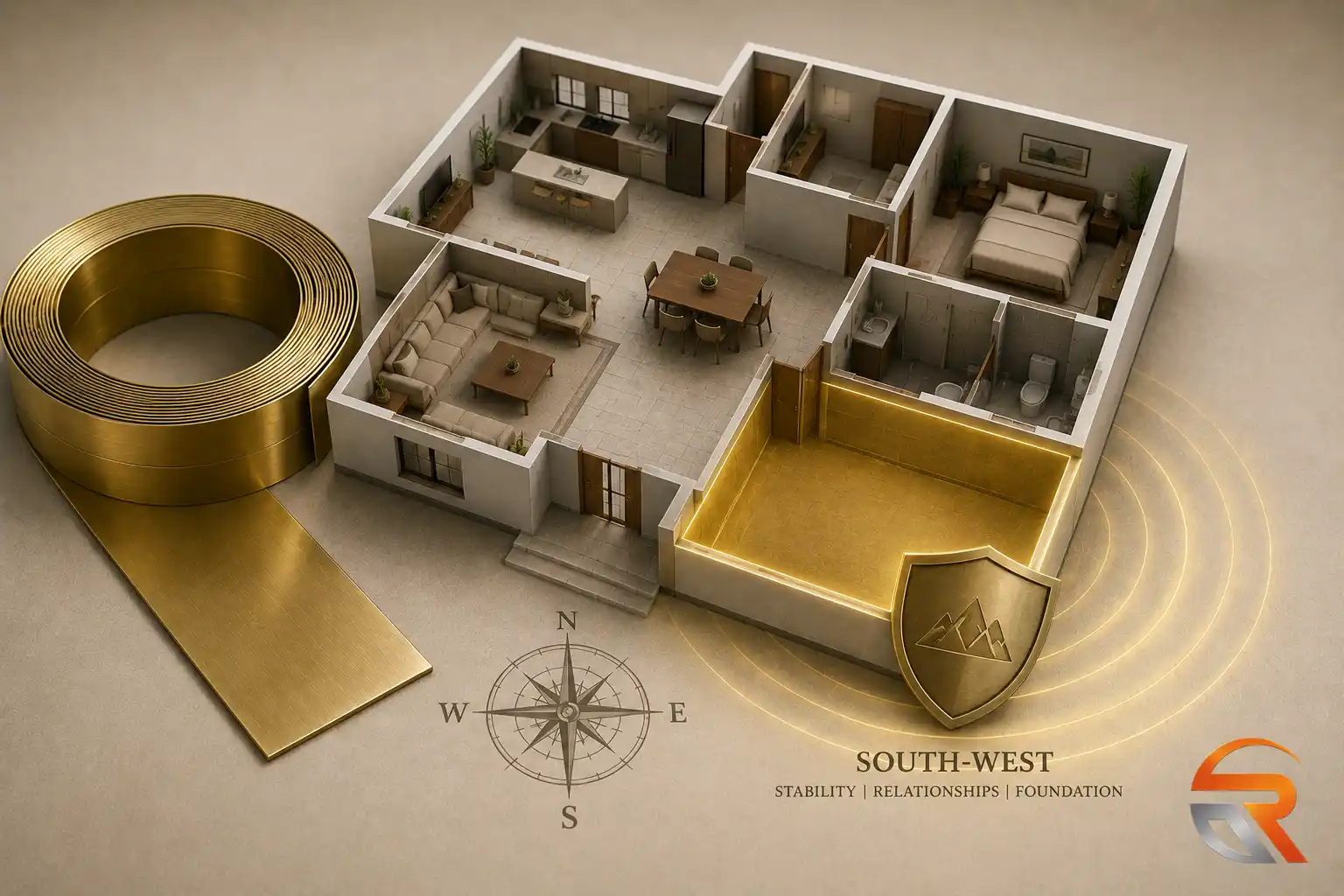
The Science of Brass and Stability
In Vastu architecture, the South-West zone governs stability, relationships, leadership, and the foundational strength of a property. This zone is strongly associated with the Earth element, which represents grounding, permanence, reliability, and structural balance. When the South-West becomes cut, extended, weakened, or improperly utilized, the property may experience instability in finances, relationships, career growth, and long-term decision-making.
To restore energetic balance in this critical zone, a material with strong grounding characteristics is required. This is where the metallurgical density and composition of brass become exceptionally effective. Brass possesses the ideal combination of conductivity and stabilization needed to reinforce Earth-element energy in both residential and industrial environments.
Why the South-West Zone Is So Important
According to Vastu principles, the South-West acts as the energetic anchor of the entire structure. It is considered the zone of control, support, authority, and stability. If this area becomes structurally weak or energetically imbalanced, occupants may experience recurring uncertainty, emotional instability, lack of business consistency, delayed growth, or relationship conflicts.
In commercial and industrial spaces, South-West imbalance can affect inventory retention, leadership consistency, employee management, and long-term financial stability. Because of its foundational role, correcting this zone requires materials capable of creating a strong and permanent grounding effect.
Why Brass for the South-West?
Brass is an alloy primarily composed of copper and zinc. This unique metallurgical combination makes it especially suitable for Earth-element correction. Copper enhances conductivity and directional flow, while zinc contributes weight, grounding, and stabilization. Together, they create a balanced alloy capable of both regulating and anchoring environmental energy.
Unlike pure copper, which is highly active and conductive, brass delivers a more stable and controlled energetic effect. This makes it the preferred choice for zones where excessive movement or instability must be reduced.
- Grounding Properties: Prevents energy leakage from the critical South-West corner.
- Structural Stability: Creates a heavy anchoring effect for weakened zones.
- Durability: Excellent corrosion resistance, making it ideal for under-floor embedding.
- Long-Term Performance: Maintains energetic consistency for decades.
- Aesthetic Integration: Easily blends into commercial and residential flooring designs.
Common South-West Defects
Several architectural conditions can disturb the South-West zone and create imbalance within a property. These include:
- Missing or cut South-West corners
- Lower floor levels in the South-West
- Excessive openings or glass structures
- Underground water tanks or borewells
- Lightweight storage or empty spaces
- Improper placement of entrances or machinery
When these conditions exist, brass strips, foils, or anchoring rods are strategically installed to reinforce the Earth-element energy and stabilize the affected area.
Applications in Residential Spaces
In homes and apartments, brass strips are commonly embedded beneath flooring, skirting, or tile joints within the South-West zone. This method allows permanent energetic correction without altering the visual aesthetics of the property.
Homeowners often implement brass-based corrections to improve family stability, strengthen relationships, support career growth, and create a greater sense of grounding within the living environment.
Industrial and Commercial Applications
Large-scale industrial projects frequently use brass anchoring in warehouses, raw material storage zones, and management areas located in the South-West section of the facility. Because industrial layouts generate heavy electromagnetic and structural disturbances, grounding becomes even more important.
Brass installations in commercial properties help stabilize inventory movement, reduce energetic imbalance created by machinery, and improve operational consistency across departments.
Floor Embedding and Installation Precision
The effectiveness of brass correction depends heavily on accurate directional mapping and precise installation. Even the highest purity material can underperform if incorrectly placed. Professional implementation involves identifying the exact South-West boundary, evaluating structural imbalance, and selecting the appropriate brass thickness and placement pattern.
At Republic Metals Vastu, all brass foils and strips are engineered for long-term architectural integration. The installation process is completely non-invasive and designed to preserve the structural integrity and visual appearance of the property.
Brass acts as a stabilizing anchor within the South-West zone, reinforcing long-term growth, emotional balance, and structural harmony without requiring demolition or major reconstruction.
The Importance of Material Purity
Not all brass materials deliver the same corrective performance. Low-grade alloys may contain impurities that reduce conductive balance and weaken the grounding effect. High-quality brass with consistent alloy composition ensures reliable energetic stabilization and superior durability.
This is why premium metallurgical standards are essential in professional Vastu correction systems.
Conclusion
Brass remains one of the most effective and scientifically aligned materials for South-West Vastu correction due to its unique balance of conductivity, density, and grounding strength. Whether used in residential flooring, commercial architecture, or industrial facilities, brass creates a stabilizing energetic foundation that supports relationships, financial consistency, leadership strength, and long-term growth. When professionally installed with accurate directional analysis, brass-based correction provides a permanent and highly effective solution for South-West imbalance.