
Copper vs. brass: the practical difference
Copper is an elemental metal. Brass is a family of copper-zinc alloys, and its exact properties vary with the alloy composition and temper. Neither material is universally better: the right choice depends on the installation, available space, required form, finish, and the advice of the Vastu professional working on the property.
This guide separates material facts from traditional Vastu practice. It does not promise financial, health, structural, or business outcomes from any product or placement.
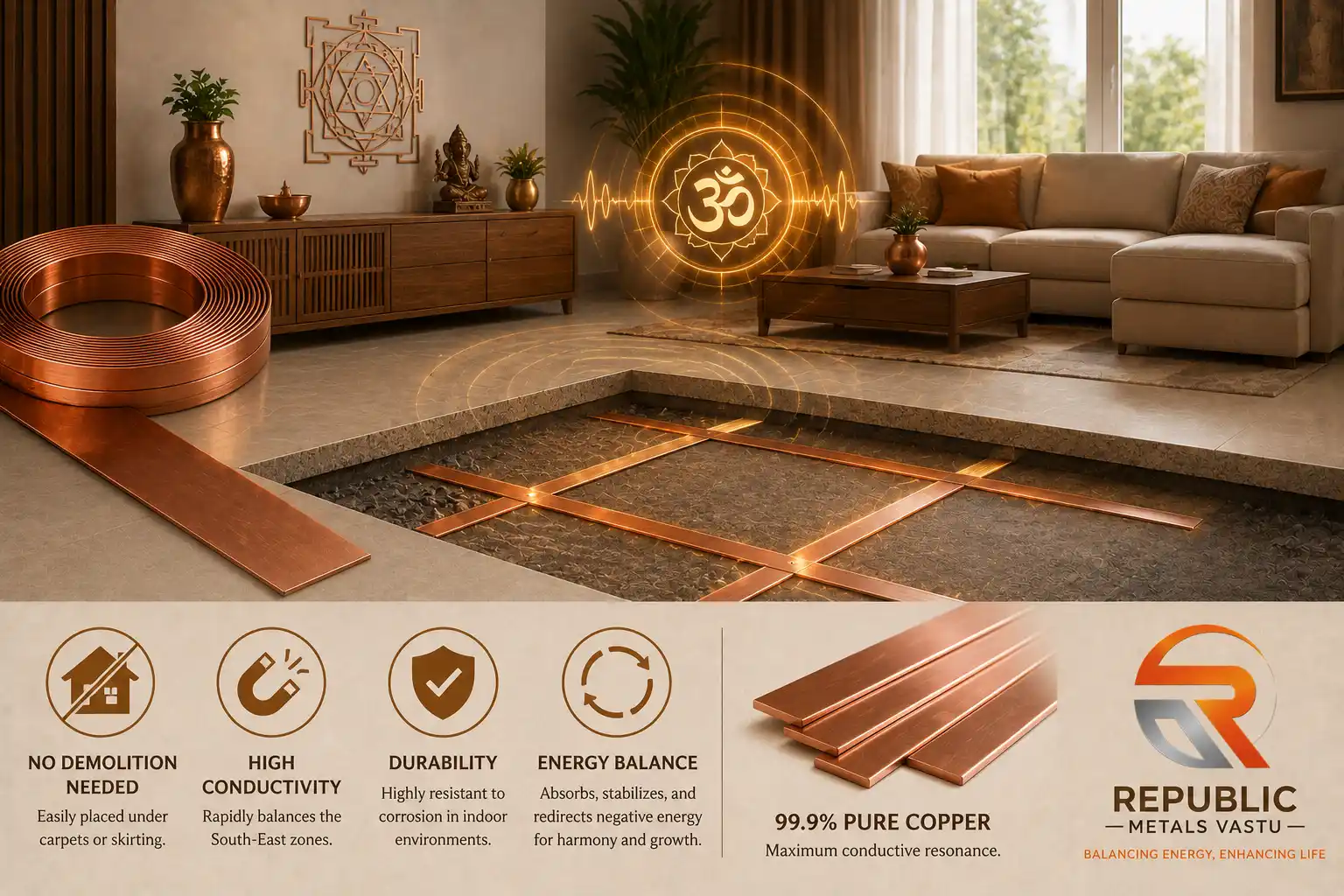
Copper strip
Copper is widely used where electrical and thermal conductivity are relevant material properties. Copper sheet, strip, plate, and rolled bar can be supplied to different grades and conditions; ASTM B152/B152M is one example of a specification covering copper strip products. The grade, thickness, width, edge condition, temper, and finish should be agreed with the supplier before fabrication.
- Ask for: material grade, thickness, width, length, temper, finish, and cutting tolerance.
- Installation check: confirm whether the strip is surface-mounted, placed in a prepared channel, or installed during construction.
- Traditional context: some Vastu practitioners associate copper with particular directions or elements; seek site-specific guidance rather than applying a generic rule.
Brass strip
Brass is a copper-zinc alloy. Its mechanical, corrosion, colour, and fabrication characteristics depend on the selected alloy; ASTM B36/B36M is one example of a specification covering brass plate, sheet, strip, and rolled bar. The supplier should identify the alloy and the intended form instead of treating all brass as interchangeable.
- Ask for: alloy designation, temper, thickness, width, length, finish, and fabrication method.
- Installation check: allow for the final floor, wall, or joinery construction so the product is protected and accessible as required.
- Traditional context: some Vastu practitioners choose brass for specific placements; that is a traditional recommendation, not an engineering-performance claim.
Comparison table
| Question | Copper strip | Brass strip |
|---|---|---|
| Material | Elemental copper | Copper-zinc alloy |
| Specification to confirm | Grade, temper, thickness, width and finish | Alloy, temper, thickness, width and finish |
| Fabrication decision | Suitability for the required form and installation | Suitability for the required form and installation |
| Vastu decision | Seek a site-specific recommendation | Seek a site-specific recommendation |
How to choose responsibly
Start with the property requirement and installation constraints. Then confirm the physical product specification with the manufacturer. If the purchase is being made for Vastu practice, obtain the placement recommendation from a qualified practitioner. Do not use a material comparison as a substitute for structural, electrical, safety, or professional design advice.
References
For technical material specifications, see ASTM B152/B152M for copper sheet and strip and ASTM B36/B36M for brass plate, sheet and strip. These references describe material specifications; they do not validate Vastu outcome claims.