
Recognizing the Signs of Imbalance
Elemental imbalances often manifest as chronic issues in our daily lives. If you consistently face financial instability, poor health, lack of focus, delayed growth, or emotional instability despite your best efforts, your environment may be energetically misaligned. Vastu Shastra teaches that the built environment directly influences the flow of natural forces around us. When the elemental balance within a property is disturbed, it can gradually affect productivity, relationships, finances, and mental clarity.
Unlike obvious structural defects, elemental imbalances are often subtle and cumulative. Over time, these disturbances can create patterns of instability that are difficult to explain through conventional reasoning alone. Recognizing these signs early allows corrective measures to be implemented before the imbalance intensifies.
Common Indicators of Vastu Imbalance
Different zones within a property correspond to specific aspects of life. When those zones become cut, extended, blocked, overloaded, or improperly utilized, they may create recurring challenges for occupants.
- Frequent Financial Obstacles: Delayed payments, cash flow instability, or unexpected losses often indicate issues in the North or North-East zones.
- Lack of Mental Clarity: Constant confusion, poor decision-making, or low focus may result from imbalance in the East or Air zones.
- Relationship Instability: Emotional stress or conflicts may arise when the South-West zone lacks grounding energy.
- Low Productivity: Industrial or office environments with distorted energy flow may experience inefficiency, downtime, or employee unrest.
- Persistent Fatigue: Poorly balanced elemental zones can create stagnant energy that affects overall well-being.
The Five Elements and Their Zones
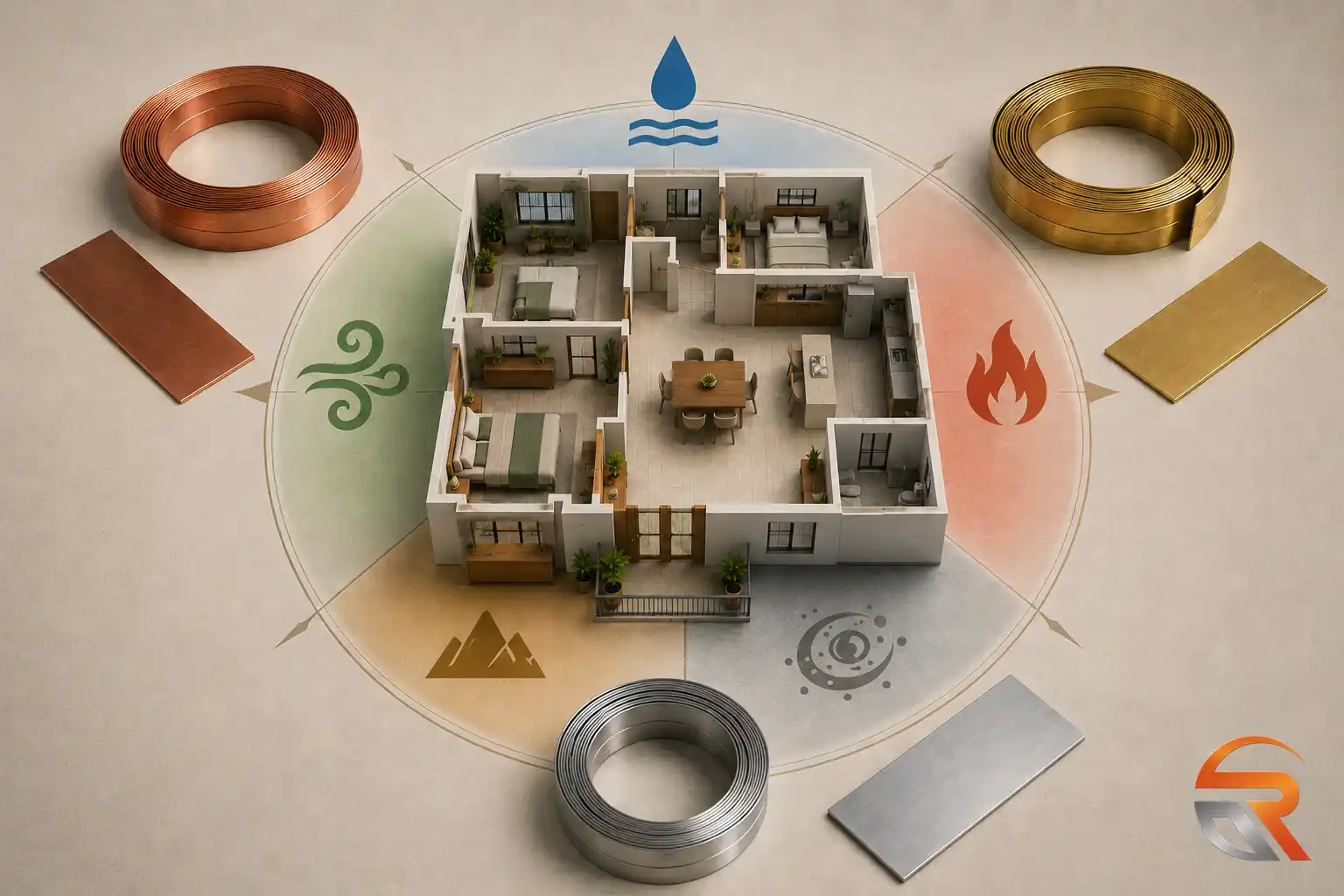
Vastu Shastra divides architectural space into zones governed by five primary elements: Water, Air, Fire, Earth, and Space. Each direction carries a unique energetic quality that influences specific areas of life and functionality.
- North (Water): Governs financial flow, career opportunities, and movement.
- East (Air): Represents growth, communication, creativity, and social connections.
- South (Fire): Controls visibility, recognition, energy, and business performance.
- West (Space): Influences gains, completion, and long-term opportunities.
- South-West (Earth): Represents stability, relationships, and grounding.
When these zones become weakened, excessively open, cut, or improperly weighted, the natural energetic balance of the property becomes disturbed. Corrective materials and directional balancing methods are then used to restore harmony.
How Metal Mapping Works
Modern Vastu correction combines traditional directional science with metallurgical precision. Each metal carries distinct conductive and stabilizing properties that align with specific elemental zones.
- Copper: Used primarily for Fire-related corrections due to its strong conductive nature.
- Brass: Ideal for grounding and Earth-element stabilization, especially in the South-West.
- Aluminium: Lightweight and responsive, commonly used for Space and directional balancing.
By strategically embedding or placing these metals within affected areas, energetic disturbances can be corrected without structural demolition. This process is known as elemental mapping, where each zone is analyzed and matched with its corresponding corrective material.
Residential vs Commercial Imbalances
The manifestation of imbalance varies depending on the type of property. In residential spaces, the effects are often emotional, financial, or health-related. In commercial and industrial environments, imbalances may appear as operational inefficiencies, machinery breakdowns, employee conflicts, or inconsistent business performance.
Large-scale industrial projects require advanced directional analysis because heavy machinery, electrical systems, and structural load distribution significantly influence magnetic flow within the property.
The Importance of Accurate Directional Analysis
One of the most common mistakes in Vastu correction is relying on inaccurate directional readings. Even minor compass deviations can lead to improper corrective placement. Professional Vastu assessment involves precise directional mapping, zone identification, structural evaluation, and material selection based on the property’s energetic requirements.
At Republic Metals Vastu, every correction begins with a detailed analysis of directional imbalance and elemental deficiency. This scientific approach ensures that the selected metal strips or nodes are positioned with maximum effectiveness and long-term stability.
Identifying elemental imbalance is the first and most critical step toward creating a balanced, productive, and energetically harmonious environment.
Conclusion
Understanding how elemental imbalance affects a property allows homeowners, architects, and business owners to make informed corrective decisions. Through accurate directional mapping and strategic use of copper, brass, and aluminium Vastu strips, it becomes possible to restore harmony without altering the architectural integrity of the space. Proper elemental balancing creates an environment that supports growth, clarity, stability, and long-term success.