
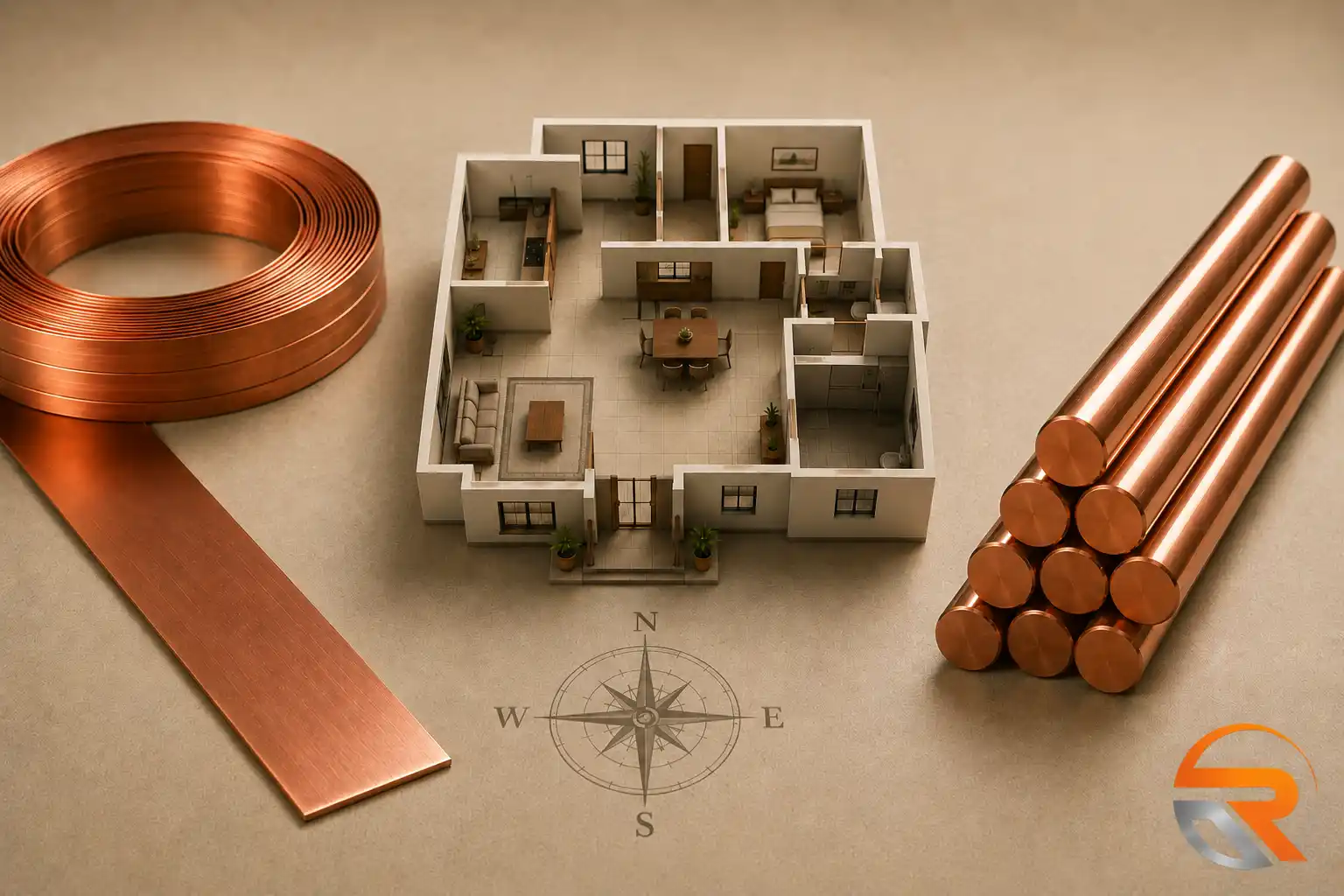
Choosing the Right Form Factor
When correcting Vastu defects, selecting the right metal is only half the equation; the form factor—whether a Strip or a Rod—determines how the energy is manipulated. Both solutions are engineered for specific architectural and energetic requirements, and understanding their differences is essential for achieving effective long-term correction.
While Vastu Strips are optimized for subtle directional balancing and continuous energy regulation, Energy Rods are designed for structural anchoring and strong boundary definition. Choosing the wrong format can reduce effectiveness, especially in large residential, commercial, or industrial properties where directional precision is critical.
Understanding the Purpose of Vastu Strips
Vastu Strips are thin, flexible, and highly conductive metal components used primarily for directional correction beneath floors, carpets, skirting, or tile joints. Their purpose is to create a continuous energetic pathway that either redirects, cuts, stabilizes, or extends the energetic signature of a specific zone.
Because strips remain hidden beneath the surface, they provide a completely non-invasive correction method without affecting the visual aesthetics of the property. They are widely preferred in apartments, offices, villas, retail spaces, and factories where discreet correction is required.
- Ideal for Floor Embedding: Easily installed beneath tiles or marble flooring.
- Continuous Energy Flow: Creates uninterrupted directional conductivity.
- Minimal Structural Impact: Requires no major demolition or reconstruction.
- Flexible Installation: Can be placed under carpets, wooden flooring, or skirting.
- Perfect for Zone Extensions: Commonly used to cut or extend directional energy.
Where Vastu Strips Work Best
Metal strips are especially effective when correcting subtle imbalances such as extended corners, missing directional support, or improper elemental distribution. Copper strips are commonly used in South-East Fire corrections, while brass strips are preferred for grounding South-West instability. Aluminium strips are often used for Space-element balancing in larger layouts.
Because of their flexibility and ease of concealment, strips are considered one of the most versatile Vastu correction tools available today.
Energy Rods: Structural and Defining
Energy Rods, on the other hand, provide structural alignment and energetic reinforcement. They are thicker, heavier, and designed to act as energetic anchors within a property. Unlike strips that create flow, rods establish boundaries and stabilize large-scale directional disturbances.
Energy Rods are particularly effective in situations where the structure lacks energetic integrity, such as missing corners, severe directional cuts, irregular plot shapes, or industrial layouts with distorted magnetic flow. Their density creates a stronger grounding effect, making them suitable for high-impact correction requirements.
- Boundary Definition: Establishes energetic borders for weak or missing zones.
- High Structural Stability: Ideal for industrial and commercial projects.
- Powerful Grounding Effect: Reinforces weakened Earth-element zones.
- Long-Term Durability: Built for permanent architectural integration.
- Strong Directional Anchoring: Effective for severe Vastu doshas and structural imbalance.
When to Choose Energy Rods
Energy Rods are often recommended for factories, warehouses, large commercial properties, and plots with major structural irregularities. In residential architecture, rods may be used when there is a significant missing corner, unstable South-West zone, or large directional imbalance that cannot be corrected effectively using strips alone.
Because rods operate on a deeper structural level, their placement requires accurate directional analysis and professional installation planning.
Key Differences Between Strips and Rods
| Feature | Vastu Strips | Energy Rods |
|---|---|---|
| Primary Function | Continuous energy balancing | Structural stabilization |
| Installation Area | Floors, skirting, carpets | Corners, boundaries, foundations |
| Flexibility | Highly flexible | Rigid and fixed |
| Best For | Subtle corrections and zone extensions | Major structural imbalance |
| Visibility | Completely concealed | May require deeper embedding |
The Role of Material Selection
Both strips and rods can be manufactured using Copper, Brass, or Aluminium depending on the elemental requirement of the zone being corrected. Material purity remains extremely important because conductive efficiency directly affects correction performance.
At Republic Metals Vastu, all products are manufactured using premium-grade metals engineered specifically for long-term architectural integration and energetic conductivity.
Professional Assessment Matters
Many Vastu issues appear visually similar but require completely different corrective approaches. A missing South-West corner may require brass rods for grounding, while an extended South-East zone may only need copper strips for balancing. This is why professional directional analysis is essential before implementation.
Incorrect material placement or improper form factor selection can reduce effectiveness and sometimes intensify imbalance instead of correcting it.
Vastu Strips regulate energetic flow, while Energy Rods establish structural stability. Choosing the right solution depends entirely on the nature and severity of the directional imbalance.
Conclusion
Both Vastu Strips and Energy Rods serve critical but distinct purposes in modern Vastu correction. Strips are ideal for subtle, continuous balancing beneath surfaces, while rods provide strong structural anchoring for severe or large-scale directional defects. By combining accurate directional analysis with high-purity metallurgical solutions, it becomes possible to restore harmony, stability, and energetic alignment without compromising the structural integrity of the property.