
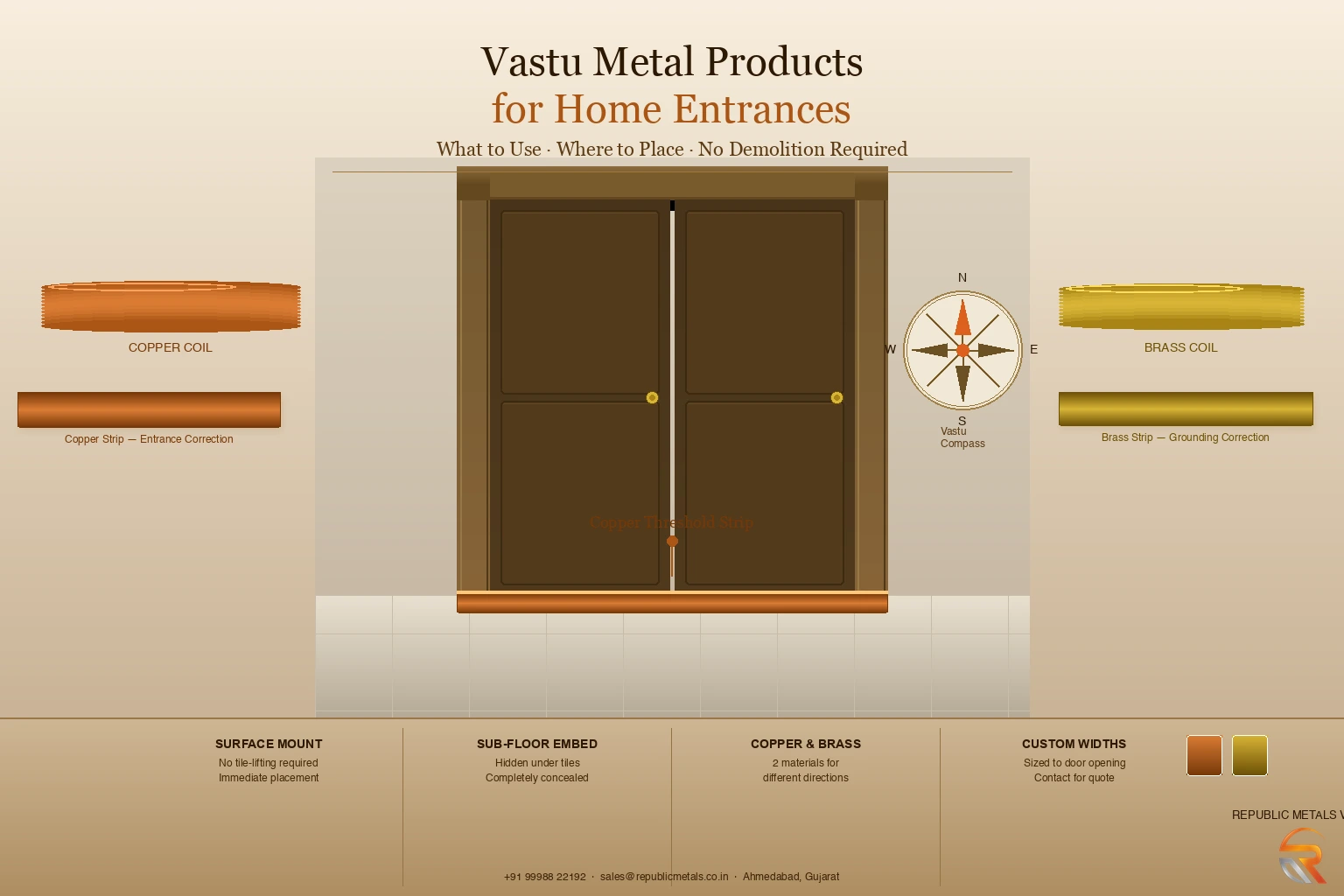
Why the Entrance Matters in Vastu
In Vastu Shastra, the main entrance of a home or building is considered the primary point of energy entry. The direction the entrance faces, its proportions, and any structural irregularities nearby are all factors that Vastu practitioners evaluate when assessing a property. An entrance facing a favourable direction and free of directional defects is traditionally considered beneficial; one with imbalances may be corrected using metal placements, threshold adjustments, or other non-structural remedies.
This guide focuses specifically on metal-based corrections — what they are, which materials are typically used, and how they are applied at entrance zones.
Which Metals Are Used at Entrances?
The two most commonly used metals for entrance corrections are copper and brass. Their physical properties — conductivity, density, and resistance to corrosion — make them suitable for threshold placement, where they may be embedded underfloor or placed along door frames.
- Copper: A highly conductive metal associated in Vastu practice with directional correction in active zones. Copper strips are often placed at thresholds facing East or South-East directions, though placement should always be confirmed by a qualified Vastu practitioner based on the specific property.
- Brass: A copper-zinc alloy that is denser and less reactive than pure copper. In Vastu practice, brass is traditionally used for grounding and stabilization. It is commonly recommended for entrances facing South, South-West, or West.
Product Forms for Entrance Corrections
At the entrance zone, the product form matters because of the space constraints involved. Two forms are most commonly used:
- Strips: Flat, rigid metal pieces laid across the threshold — either visible as a trim strip or embedded beneath the floor covering. A copper or brass strip across the full width of the doorway is the most common form of entrance correction. Republic Metals Vastu supplies strips in custom widths and lengths to match the exact door opening.
- Foils: Thin, flexible metal sheets suitable for placement under tiles or flooring at the entrance zone, where the strip form would be too rigid or too thick to fit under the floor finish. Copper foil is particularly suited to this application when the floor is being laid or retiled.
Does the Entrance Direction Affect Which Metal to Use?
Yes, according to Vastu Shastra principles. Different directional zones are associated with different elements, and those associations guide the choice of metal. However, the exact recommendation depends on more than just the direction the door faces — the full property layout, the zone mapping, and any existing structural features all factor into a precise recommendation.
A qualified Vastu professional should confirm the material, product form, dimensions, and placement before ordering. Republic Metals can then supply the product to the required specification.
How Are Metal Products Placed at the Entrance?
The most common methods of placement at the entrance zone are:
- Sub-floor embedding: The strip or foil is placed directly beneath tiles, marble, or flooring at the threshold. This is completely concealed and requires no visible change to the entrance. It is easiest to implement during construction or renovation but can also be done by temporarily lifting the threshold tile.
- Threshold trim: The strip is placed directly on the floor surface across the doorway, functioning as a traditional threshold trim. This requires no tile-lifting and is immediately reversible. The strip sits flush with the floor and is typically only millimetres thick.
- Door frame placement: In some applications, a thin strip or wire is placed around the interior of the door frame. This is less common but may be recommended for specific directional corrections.
Can Entrance Corrections Be Done Without Demolition?
Yes. This is one of the main advantages of metal-based Vastu correction. The strip or threshold trim method requires no floor demolition, no wall-breaking, and no structural modification. The sub-floor method requires only the temporary lifting of the threshold tile, which can typically be replaced without visible damage.
For rental properties, builder apartments, or any situation where structural work is not practical, the threshold trim method provides a fully reversible correction option.
What Dimensions Should I Order?
The strip should be wide enough to span the full internal width of the door opening. Standard residential door openings in India are typically 900mm–1000mm wide, but this varies. The thickness of the strip is usually determined by what the flooring finish can accommodate — surface-mounted strips are typically 1mm–3mm thick to remain flush underfoot.
Republic Metals Vastu supplies copper and brass strips in custom dimensions, including custom lengths, widths, gauges, and edge finishes. Contact the team at +91 99988 22192 or sales@republicmetals.co.in with your door width, flooring type, and installation method to get the right specification.
How to Order Entrance Correction Products
Republic Metals Vastu products can be ordered by requesting a quote on the website or by contacting the team directly. The team is based in Ahmedabad, Gujarat, and supplies products across India. To place an order, provide: the door opening width, the installation method (surface or sub-floor), the preferred material (copper or brass), and any specific finish requirements. Custom lengths and bulk quantities are available.