
The Challenge of Industrial Vastu
Balancing a massive 50,000 square foot manufacturing unit presents unique challenges that go far beyond residential Vastu correction. Industrial environments contain heavy machinery, electrical transformers, large-scale metal infrastructure, high-voltage zones, and continuous operational movement — all of which significantly influence the energetic balance of the property.
In this case study, we examine a large manufacturing facility in Gujarat that experienced recurring machinery breakdowns, inconsistent production output, labor unrest, delayed dispatch cycles, and unstable operational efficiency. Despite upgrading machinery and improving internal processes, the management team continued to face unexplained disruptions across departments.
After a detailed directional and structural analysis, multiple energetic imbalances were identified within the factory layout, particularly around the machinery zones, raw material storage areas, and outer structural boundaries.
Understanding Industrial Energy Distortion
Unlike residential spaces, factories generate intense electromagnetic and mechanical disturbances due to continuous industrial activity. Heavy motors, conveyor systems, fabrication equipment, and electrical panels create concentrated magnetic interference that can distort natural directional flow within the property.
Large open layouts without energetic boundaries can also lead to unstable movement patterns, inefficient workforce flow, and imbalance between operational departments. In many industrial projects, the absence of proper directional grounding affects not only productivity but also employee coordination and long-term business stability.
Because of the scale and complexity of industrial structures, standard residential Vastu remedies are often insufficient. Large commercial properties require engineered metallurgical correction systems designed specifically for high-load architectural environments.
Initial Site Analysis
During the initial assessment, several key issues were identified within the factory layout:
- Major machinery clusters positioned in energetically conflicting zones
- Unstable South-West storage area causing inventory inconsistency
- Distorted boundary alignment around the North-West section
- Excessive electrical concentration disrupting directional balance
- Poor energetic circulation between production and dispatch units
These imbalances were contributing to operational inefficiency, increased maintenance frequency, and workforce instability.
The Solution: Custom Elemental Grids
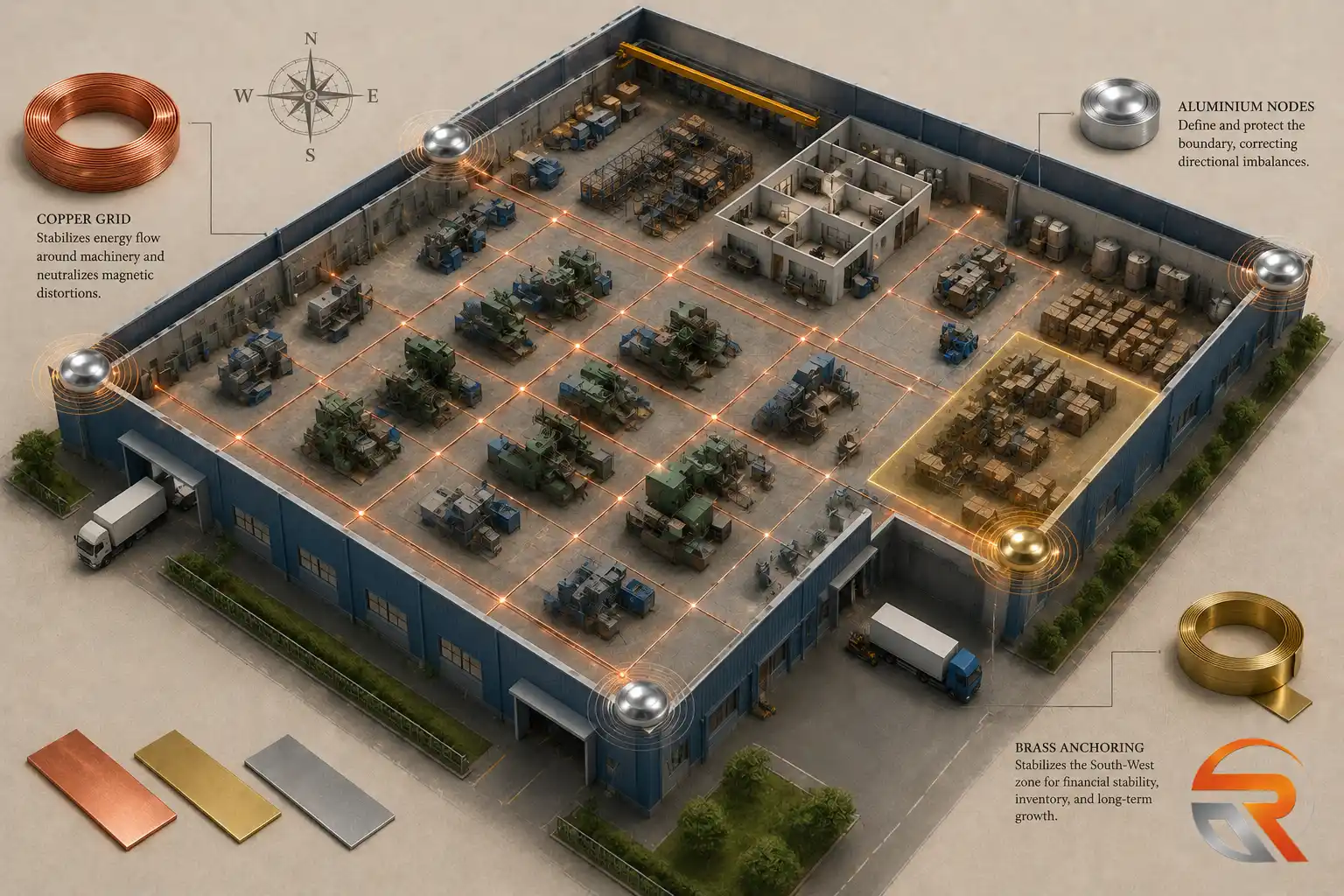
To restore balance across the facility, Republic Metals Vastu implemented a multi-layered industrial correction strategy specifically engineered for large-scale manufacturing infrastructure.
- Copper Gridding: Heavy-duty 99.9% pure copper wires were embedded around primary machinery clusters to isolate magnetic distortion and regulate energetic flow.
- Aluminium Nodes: Precision aluminium nodes were installed at key structural corners to redefine directional boundaries and improve spatial balance.
- Brass Anchoring: Brass strips were embedded within the South-West raw material storage zone to stabilize inventory movement, financial consistency, and operational grounding.
- Directional Mapping: Every installation was aligned using high-precision compass calibration to ensure maximum corrective effectiveness.
Why Copper Was Critical
Copper played a central role in the correction system because of its exceptional conductive properties. Industrial machinery generates concentrated electromagnetic interference that can disrupt natural environmental balance. Copper grids helped absorb, regulate, and redirect this excess energetic concentration while reducing instability around critical production equipment.
The use of high-purity copper also ensured long-term conductivity and corrosion resistance within the industrial environment.
The Role of Aluminium Nodes
Aluminium was selected for structural boundary correction because of its lightweight energetic responsiveness and adaptability within large-scale layouts. The factory’s irregular perimeter had created directional inconsistencies that weakened spatial stability.
By installing aluminium nodes at strategic structural points, the energetic outline of the factory was redefined, helping restore balanced directional containment across the property.
Brass Anchoring for Stability
The South-West section of the factory was used for raw material storage but lacked sufficient grounding energy. This resulted in irregular stock movement, delayed inventory turnover, and inconsistent financial cycles.
Brass anchoring strips were embedded beneath the flooring within this zone to reinforce Earth-element stability. The combination of copper and zinc within brass provided the grounding effect necessary to stabilize operational flow and inventory retention.
Implementation Without Operational Shutdown
One of the biggest advantages of metallurgical Vastu correction is that it can often be implemented without disrupting day-to-day operations. The factory corrections were completed in phases to ensure production continuity throughout the process.
Most copper and brass embedding work was carried out beneath existing flooring channels, while aluminium nodes were integrated discreetly into structural boundary points.
Measured Results After Implementation
Within approximately three months of implementation, the factory management reported several measurable improvements across operations:
- 40% Reduction in Machinery Downtime
- Improved Workforce Coordination and Stability
- Faster Inventory Movement and Dispatch Efficiency
- Reduced Operational Delays
- Noticeable Improvement in Overall Workflow Smoothness
While Vastu correction is not a replacement for operational management, the project demonstrated how environmental balance can significantly support organizational efficiency when combined with proper industrial processes.
The Importance of Customized Industrial Solutions
Every factory has a unique structural footprint, machinery distribution pattern, and directional layout. This is why industrial Vastu correction cannot rely on generic solutions. Effective correction requires detailed site analysis, directional mapping, material selection, and metallurgical engineering tailored specifically to the operational environment.
At Republic Metals Vastu, industrial correction systems are designed to integrate seamlessly into existing infrastructure while preserving structural integrity and minimizing disruption.
Large-scale industrial Vastu correction is not about superstition — it is about restoring balance, flow, stability, and directional harmony within complex operational environments.
Conclusion
This 50,000 sq ft factory project demonstrates how strategically engineered copper grids, aluminium nodes, and brass anchoring systems can restore energetic balance in large industrial spaces. By combining traditional Vastu principles with modern metallurgical precision, it becomes possible to improve operational stability, reduce disruption, and create a more harmonized manufacturing environment without invasive reconstruction or downtime.